Tuesday, January 31, 2006

I'm on a Tolkein kick

After last Thursday night -- when I had the wonderful pleasure of spending three hours with two dear friends, discussing a wonderful fable by JRR Tolkein called Smith of Wootton Major -- I decided maybe I should look into some of his lesser read stories and essays. [I have to confess that Hobbit is ok, but I've NEVER been able to really get the Rings trilogy!]

The kids and I have recently finished reading Farmer Giles of Ham and are about half through with Roverandom -- both well-worth purchasing! But I wanted to find others that might be fun to read -- either for the kids or me (or both!).

I found a wonderful website that lists all things Tolkein -- filled with reviews of (as far as I can tell) all his wonderful essays and stories. Here I found reference to Mr. Bliss, The Adventures of Tom Bombadil and a book called Tree and Leaf. My public library had them and I picked them up yesterday.

What a treat!

Mr. Bliss
I read Mr. Bliss to the littles today as a change from dogs -- sled and imaginary -- and what a wonderful, silly book. It's neat because it's a facsimile of Tolkein's hand-written story with pictures that he did for his boys. It's a tad annoying because the facsimile is on every right-hand page while printed text is on every left-hand page -- this slows the story a bit, but it's still a wonderful read.

The story -- partially autobiographical -- deals with a man's purchase and use of his first car. The incidents that occur -- such as crashing into an old neighbor 's barrow full of cabbages (you've got to see the illustration!) -- are realistic but bordering on the fantastic. It's a comedy of errors type of story with Tolkein's blend of beautiful prose.

This is definitely worth haunting alibris.com or other used book site for a copy!

The Adventures of Tom Bombadil (and other verses from the Red Book)

I made the mistake of trying to read this to the littles at the end of our morning -- before lunch. I was tired and didn't give the poems the "spunk" they needed and the kids were tired of hearing my voice. I'm going to re-try on Friday -- when I can really get into the drama/silliness of the poems. I think that will help the children really enjoy these clever (and humorous) stories. The volume I got from the library is illustrated by Pauline Baynes (who seems to have illustrated many of his children's books).

I'm going to search for a used copy of this one too -- maybe for the littles when they're older. The poems are that good!

Tree and Leaf

This little volume I dipped-into while the kids were at quiet time. The introduction by Christopher Tolkein sets the stage for the rest of the book. There are three parts:
  • the famous essay "On Fairy Stories"
  • the short story "Leaf by Niggle"
  • a long poem, "Mythopoeia"

All three carry the theme of trees and leaves. All three deal with fantasy and myth. All three seem to have Tolkein's exquisite ability with language. I was able to start the "On Fairy Stories" which is a wonderful lecture Tolkein gave on what makes a fairy story, the distinction between "fairy" and "faery" and other fascinating information about the world of the fantastic. This essay is quite readable -- well, until BamBam awoke!

Monday, January 30, 2006

When the book is better than the movie....

Thanks to a suggestion from Gladys Hunt's Honey for the Woman's Heart, I read -- and thoroughly enjoyed -- I Capture the Castle by Dodie Smith. (see archived article: St. Athanasius Academy: Reading List Review: I Capture the Castle). When reading a bit about Dodie Smith I discovered that she wrote the book 101 Dalmations which inspired Disney to create a cartoon that is much loved around our house. I checked the library catalog and, wonder-of-wonders, they had.

Well, I started to read this book to see if my littles would enjoy it. Then I decided to start it as a lunchtime-read aloud (which includes the older two -- 16 and 14 year-olds). We are so enjoying this book that makes the movie insipid in comparison. in the book Cruella is married (can you imagine?), eats pepper on everything, wear's furs all the time (even sleeps on ermine sheets) and is thoroughly BAD (makes Glenn Close's Cruella seem tame)! The Dearlys and their domestic help -- their nannies from when they were little -- share the house with the Pongo and Missis Pongo and later, Perdita (the foster mom dog who comes to help nurse the 15 puppies).

This is a fantastic read for anyone who loves dogs or who loves the Disney version. This is SOOOO much better!

Saturday, January 28, 2006

Living Knitting -- Mr. Popper's Penguins


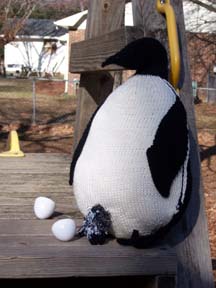
After a few months of "encouragement" (aka, nagging) from BamBam to make him a penguin like in the book we read (Mr. Popper's Penguins by Richard Atwater) we now have the finished knitted Captain Cook -- that fuzzy thing in front is a baby penguin and there's a plastic egg off to the left. Yes, I even made a brood pouch for the Captain.....

there's nothing quite like Living Books to create a few rabbit trails for us!

Finishing Up Our Castle Unit

To put the finishing touches to our unit on castles and all things medieval, I had the Lego Maniac and String Bean each narrate a story for me that they then illustrated.

We had two books from the library that helped with this endeavor:
  • 1-2-3 Draw Kights, Castles, and Dragons (by Freddie Levin). This is a very easy to follow drawing book that has all kinds of wonderful drawing ideas. Basic people -- standing, sitting, running or side views -- are described and then "dressed" to show how to make a princess, queen, king, jester, minstrel or knight. Drawing dragons in action, horses galloping and falcons perched are broken down into easy to understand shapes that are then colored to enliven the drawing. Castles, weapons and coat-of-arms are also detailed. This is a great beginning drawing book.
  • Draw! Medieval Fantasies (by Damon J. Reinagle). This one was a bit more difficult -- String Bean didn't even try and Lego Maniac gave up after about 45 minutes of really trying. This book would be better in the hands of a 10 or 11 year old. But the techniques are well illustrated and would be a great resource for those interested in creating comic-book type illustrations with lots of detail and action. Definitely one to remember when Lego Maniac is a bit older.

Another book we had gotten from the library, but ran out of time to use, was unique and Ill need to remember it next time we do the Middle Ages. Origami in King Arthur's Court - An Adventure in Folding (by Lew Rozelle) is a jewel! Castles, knights, a joust, Merlin's Castle (including the inhabitants), Camelot, and the Royal Hunt are the subjects of the chapters. And the items look wonderful! The knights look like knights, the dragon looks like a dragon and Merlin's sorceress looks like an old hag. This is one for every knight and castle afficianado!

Friday, January 27, 2006

Here's one of the reasons I homeschool

"Disorder in society is the result of disorder in the family. "
– St. Angela Merici

(BTW, it's St. Angela's feast day today....."St Angela, pray for us!")

Thursday, January 26, 2006

A Tolkein Faery Tale

Tonight I had the chance to meet with 2 of my dear friends and have a ladies' night. We try to meet every couple of weeks so as not to be too much of a burden for our dear husbands. Each time we meet, to make it official, we choose something to read and discuss. Last time it was Frost's poetry, the time before was Chesterton's "Blue Cross"....well, you get the idea.

This week we read a fable by JRR Tolkein, a true faery story, called Smith of Wootton Major. Definitely worth a read if you've never read it. It's a fascinating fable about imagination, gifts given and shared, and the land of faery. Please note the "ae" in faery. This is not the pink, fluffy cottony world of fairy tales. This is the land of faery where things can be menacing as well wonderful; scary and wonderful all at the same time.

By Tolkein's reckoning, fairy tales and fairy land are for the superficial -- the icing on the cake eaters. Faery land and tales of faery are for those with a bit of the fey in their soul, for the chosen few who get to walk and experience faery.

We had a delightful time sharing this book together. The phrasing and descriptive pasages are sheer poetry while the overall story (only 59 pages) is one for re-reading often.
****** ***** ***** ***** ***** ***** ***** ***** ***** ***** *****
On a separate note -- I just started reading another Tolkein book to the littles. Roverandom was published posthumously. It's basically a story about a real dog who is turned into a toy dog by a wizard, then lost and found by another wizard who helps the dog become real again. It is pure delight for the children .... and mom!

Someone mentioned that his short story, "Leaf by Niggle" is a particularly good story to read. I will check that out next (it's in his "Leaf and Tree" book) as well as his book, Mr. Bliss.

I'm on a Tolkein rabbit trail -- I'll keep you posted about the trip.....

Wednesday, January 25, 2006

Our Olympic Hopeful

Thanks to a good friend's post at the 4Real forum, we have found our Olympic athlete to cheer for when the Winter Olympics start in February.

Rebecca Dussault is a cross-country skier from Colorado. She's a faith-on-your-sleeve, in-your-face kind of Catholic and proud of it. She's chosen as her patron Blessed Pier Giorgio Frassati -- a young Ctholic leader who loved skiing. She's been homeschooled and plans to homeschool her hoped-for large family (at this point, she only has one boy and he's 3).

She's the kind of woman I want my daughters to look to for inspiration. She's the kind of athlete I want my boys to look to for guidance. Check out her website -- it's amazing what she is willing to say and do!

Go Rebecca!

Johannes Chrysostomus Wolfgangus Amadeus

As Mr. Mozart celebrates his 250th birthday on Friday, January 27th, we have started a small unit on this legendary composer.

Today we read three pictures books that each take a slightly different slant on the composer's life.

  • Mozart: Scenes from the Childhood of the Great Composer (by Catherine Brighton) looks at Mozart's younger life through the eyes of his sister, Nannerl. She is 4-1/2 years older than Mozart and together they charm Europe as musical prodigies -- Mozart at the ripe old age of 5 and Nannerl (9) travel to Vienna (it must have been a lovely trip down the Danube) and then to Paris and London -- playing for the royal houses of Western Europe. When the family -- Papa, Mama, Nannerl and Wolfi -- return to Salzburg years later, the boy is stricken with small pox. Nannerl gets it also and the two lie in bed for many weeks when "by the grace of God, we recovered, and the music lovers of vienna were able to see Wolfi and me perform." The story ends when Nannerl is 16 and "retires" from the public eye; Wolfi and Papa go on to Italy and the next part of Mozart's career. This is a wonderful book with lovely drawings and easy-to-read aloud text.
  • Wolferl - the first six years in the life of Wolfgang Amadeus Mozart (by Lisl Weil) takes a less personal approach to Mozart's young life. The focus is much more on Mozart as a child prodigy -- playing the violin perfectly at the age of 5 (after having taught himself), playing the organ (and hitting the pedals by standing on tip-toe), and playing for Maria Theresa of Austria and the Hapsburg clan (including mention of the famous scene when Mozart proposes to Marie Antoinette -- later Queen of France). This book ends with the time in Vienna and doesn't discuss the trips to Paris, the long stay in London or the time in Italy. A short glossary in the back assists in understanding the types of music Mozart wrote and other things that the reader may not know. The pictures are beautifully drawn pastel drawings with an almost cartoon-like feel. The text is story-like and the littles enjoyed it.
  • Young Mozart (by Rachel Isadora) again focuses on his young life but actually brings his story through his young adult life, marriage to Constanza, and death at the young age of 35. This book points out that Mozart died a pauper but his fame grew after his death -- to carry forward 250 years later.

Tomorrow, we'll read more and listen to some of Mozart's gorgeous music. Friday, we'll have a birthday party for the great Austrian -- including Kugelhuf for a cake and homemade Mozartkugeln for a snack during movie night.

Now this is dying with dignity!

Here's a link to an article that ALL should read:
Allow Afflicted Babies Death with Dignity by a woman from Alaska. How much more beautiful is that than having the child induced, or aborted in some other way. This baby lived 32 quality-of-life days!

Blessings to this family for sharing their story with the world!

Tuesday, January 24, 2006

Why we've been quiet the last couple of days ....

is because my dh's school has the MLK holiday this Monday and Tuesday annually so that some of the high school students and faculty can drive up to D.C. (a 9-hour drive from here) to participate in the Annual March for Life (a cause you can bet MLK would staunchly support!). They go up on Saturday, do a bit of sightseeing, attend the Pro-Life Mass at the National Bascilica on Sunday evening, and march from the Washington Monument to the steps of the Capitol Building.

This year, Brikhead went along and had a wonderful time -- despite the rainy, cold dampness, the 9-hour drive in an 11-passenger van with capacity seating (and he's 6ft-1") and staying in the Red Roof Inn in Chinatown (a place I don't think I'd even want him to walk through, let alone stay at!).

But it was well worth it for him to see there are other teens who are fired up about right-to-life issues, teens who came from all over the country just to show their solidarity, teens who stayed in the same hotel where the electricity went out and the water never got cold. All to make a statement.

Was the statement heard? It was by Brikhead! And, for me, that's enough for now!

Reading List Review: When do you put down a book?

We have a rule for all the chapter-book readers in our house. You must give a book a 10-20 percent chance and then if you still aren't "into it" you may put it down and choose another. So, if a book is 100 pages, a minimum of 10-20 pages must be read before dismissing the book. This of course means that a 900+ page book must be given a fighting chance by reading 90-100 pages.

This is what I did with Edith Pargeter's The Heaven Tree Trilogy. I gave it a good shot. I read more than 100 pages and not one single page caught me. It was dry, convoluted and too "deep" for me. Much too much detail and didn't grab this reader at all. This was a book recommended by Glady Hunt in her Honey for a Woman's Heart. So that's one book down.

Next, I picked up Pillars of the Earth by Ken Follett. Again, a very large paperback. Again, I read the requisite 10-20 percent. Again, I had to put it down. Follett's book is full of overly graphic detail of urders and dismemberment. Follett, whose spy books my dad used to read but were so full of graphic details that he wouldn't let us read them, had a good idea. Let's write a book about the building of the cathedrals. But this one just didn't "catch" me either.

So now I'm reading Joanne Ohanneson's Scarlet Music, a fictionalized account of Hildegard of Bingen. It's a good read -- caught me almost right away -- and, so far, has avoided some of the feminist propoganda that usually surfaces in discussions of Hildegard and her intensity and independence. So far so good!

=====
Lest you think I'm wimping out by not finishing every book I pick up, please let me explain.

I teach writing to students. I teach them how to write all different types of writing -- research papers, memoirs, personal essays, short stories. One of the first things I demand from my students is to catch the reader immediately and weave in the descriptive bits. Yes, they're necessary for the reader to picture the story -- but descriptive bits are an aid to the story not the story itself. I think often writers get caught up in the poetry of their descriptions that they forget ot move the story along. NONE of the classics has this problem. I don't allow my students to have this problem. Why should I expose myself (or my family) to writers that have this problem?

Friday, January 20, 2006

Living the Learning

One of the great benefits for me about homeschooling is being so involved in my kids' learning. Some days, though, I just feel like things aren't getting in where they're supposed to.

Last night, String Bean proved me wrong. It was after dinner, I was (as usual) writing on the computer and String Bean came and showed me a story she'd written (well, she doesn't really write, but she told me what the squiggles said). As she told me the story, I started typing it up, amazed at her story-telling abilities.

Today, I'd like to share this story:

Once there was an Indian who went to Church every Sunday. One day he went all the way from his little house to the chapel. He saw a beautiful lady. The Lady said, “do not fear me. I want a Church to sit right near here where I am standing. Tell the bishop that I want a Church built right here.”

So he went to the bishop and said, “a lady dressed in white and blue wants a church right where she is standing”. The bishop said come back here another Sunday.

So he saw the lady again. She told him “please cut me some roses over there.” He was kind of mixed up because he didn’t see the roses before. So he cut the roses and put them in his tilma and the next time the Bishop said “what do you have in that pack”

And the Bishop and his men were looking at the roses and at the tilma. He looked down when he opened his eyes again, in his tilma there was nothing but a picture of the Lady of Guadalupe. “We should build a church at once.”

And so they did and now everybody goes there and sees the Lady of Guadalupe. Many people published this book because a little girl wrote it when she was five.

The End.


The last time we talked about Our Lady of Guadalupe was on her feast day, Dec 12th! Pretty good for an almost 6 year-old, huh?

Thursday, January 19, 2006

Castle Books, part 3

Today, amidst Star Wars lego sets, xbox games and other post-birthday paraphernalia (as well as post birthday sugar jags) we did accomplish quite a bit in the homeschool classroom. We even read four more castle books. Here's our take on these books:
  • Eyewitness Books: Castle (by Christopher Gravett). Like all of these "Eyewitness Books", this is eye candy for the castle enthusiasts. Lots of great and unique pictures of all things medieval that have ANYTHING to do with castles. Such things as a gold lion water pitcher from Germany, clothes of the era, and different styles of castle architecture can be found in this book. This book has a great mix of authentic artifacts and modern folks dressed up to look like those of days gone by. The text is OK, but the pictures are well worth perusing the book.
  • Life in the Middle Ages: The Castle (by Kathryn Hinds) has splendid pictures and excellent text. Many sidebars make for fun facts -- including a recipe for homemade marzipan (which we will attempt next week). The pictures are primarily taken from period tapestries or paintings done in the Middle Ages. This is a heavy fact-based book that is pretty readable and the pictures are glorious.
  • The Age of Castles: How Castles were Built (by Peter HIcks) is a wonderful overview of the architecture of different types of castles from different countries and in different eras. Excellent photographs, mixed with detailed cut-away illustrations, complement the entertaining text. Plans for building a model castle -- using tightly rolled newspaper for the towers -- are included as is a very well-done timeline of famous castles (spaning 950 to 1708). A real boys' book of castles!
  • A Medieval Feast (written and illustrated by Aliki) is a wonderful story about the king and his retinue's impending visit to a manor house. The manor house gets all ready in preparation for the all-day feasting -- wonderful descriptions (highlighted by colorful and informative drawings) of the kinds of breads, meats, fruit and vegetables, herbs and seasonings, desserts and drinks that are served to the royal guests abound in this book. Aliki's illustrations are bright and colorful -- just begging for chidren to look closely at the "Cockentrice" and the stuffed and re-feathered peacocks, as well as all the other delicacies. This book really gives an excellent picture of just what they all ate back in the "old days".

We'll probably finish up this unit tomorrow but we'll carry the knowledge of castles with us for a long, long time!

Wednesday, January 18, 2006

A Day in the Life ...

Well today is Legomaniac's birthday so what's he getting? Legos, of course. He's due home any minute after having gone to Narnia with Dad (a surprise he WASN'T expecting). If we've timed it all right, the Pizza Hut driver will be here right at the same time -- I love it when all things come together!

Today we started winding down our castle/medieval unit. Finished El Cid -- have I mentioned lately how much I loved this book -- and read a couple of fairy tales. Legomaniac reminded me that we own a perfect book for this unit The Barefoot Book of Knights -- duh! I'd bought it for him last year for his birthday! [I really need to find a way to catalog what we've got so we don't order duplicates and we don't "forget" when we own perfect books!] We'll finish off the week with castle type crafts -- building castles, narrating our own fairy tales, and other projects are on the agenda.

We're almost done with Farmer Giles of Ham -- which is also a wonderful story.

The only problem with winding down units is that I'm already contemplating our next study -- we're going to be Alaska-bound for the Iditarod project and we'll do a short unit next week for Mozart's 250th birthday -- with lots of memories of Austria and eating Mozartkugeln....

More castle book reviews tomorrow.....

Tuesday, January 17, 2006

Castle Books, part 2

Today, we started up again with our Castle books. Here are the ones we used today:

  • Life in a Castle, (by Kay Eastwood). This is a beautifully illustrated book that discusses types of castles (from "motte and bailey" to stone, Crusader and forts), defenses, community amid and among castles, separate areas of castles (keep, great hall, solar, bailey) and beyond the castle walls. Also a neat chapter on why castles declined. Very readable.
  • Fast Forward Castle (by Nicholas Harris, illustrated by Peter Dennis). This one is OOP, but well-worth borrowing even on ILL from your library. It starts with a fortified Celtic village in 600 bc and each succeeding double-page illustrates the changes that have been done to the castle -- from 1100 through to its final life as a real castle in the 1340s to its deterioration in the early 1800s to its partial renovation as a living museum today. Lots of information packed pictures with very readable text.
  • Castles and Forts (by Simon Adams - Kingfisher Knowledge series). This is a treasure trove of information. Not only does it show photos of real castles as well as artist renditions, it also has tons of web sites and other sources to enrich a student's research into castles. (For example, explore Caerphilly Castle in Wales at www.castlewales.com/caerphil.html ) This is also one of the few books that goes beyond Western Europe to define castles -- Japan, India, Turkey and Palestine are areas shown that had their share of castles. This book also discusses forts as more recent castles and the role they've played in history -- Fort Sumter and the Civil War, Fort Douaumont and World War One. Excellent!
  • Here's one that is worth buying used as it's OOP. Crusades: The Struggle for the Holy Lands is written by Melanie Rice and is an excellent overview of the Crusades -- who was involved, why did it start, where did all this happen. This is a DK Discoveries book, so I knew the illustrations would be wonderful but this goes beyond many DK books. The maps are clear; the writing is balanced and (so far -- we've read the first couple of chapters) unbiased; and the explanations are clear enough for Legomaniac to really understand and think through. The distances that were involved, the different cultures and religions that were clashing, the political and social sides are well revealed in this book. Definitely a keeper!

Enjoy!

Reading List Review: I Capture the Castle

I finished Dodie Smith's, I Capture the Castle, this past weekend. What a delightful book. It'd be an excellent read for a teenaged girl. It's got all the right things: a bit of romance, sacrifice, familial love and loyalty, hardships overcome. It's got a bit of a fairy tale feel to it -- which makes it even better in my mind.

A 17-year old Cassandra writes in her journal all of her reactions to all that happens to her family. She is the daughter of a famous one-novel man who has lost his drive to write; the family is destitute and living in a crumbling castle in 1930s England. Her older sister HATES being poor, her younger brother is in school and seemingly oblivious to the destitute-ness of the family, and Cassandra records it all. She too wants to be a writer and practices with her journal.

A wonderful book written by the author of 101 Dalmations which is MUCH better than the Disney version!

Now, on to The Heaven Tree Trilogy by Edith Pargeter (her penname is Ellis Peters, of Cadfael ) fame.

Monday, January 16, 2006

And the dream is slowly coming true....

While (seemingly) the world is off today to honor Dr. Martin Luther King, Jr., our little part of the world had school. Dh's school had school today so they could have next Monday and Tuesday off to join in the National Right to Life March in Washington D.C. So, when dh has school, we do too!

Now, I wasn't too hard on them -- just a bit of table time (which String Bean loved as she got to use her new math and phonics workbooks she got this past weekend as she'd already finished CHC's Letter Practice for Little People and Number Practice for Little People) and lots of cuddling on the couch to read fairy tales, El Cid (almost done with this one) and Farmer Giles of Ham.

We also chatted about MLK. Lego Maniac asked if he wasn't that Black president who got killed. I explained, no he wasn't a president but he tried to get everyone to understand that all kids should be able to play together. Lego Maniac's response "well, duh! Why should it matter what color they are?" As long as they're boys and can ride bikes or play soccer, Lego Maniac will move heaven and earth to play with them. He was incensed when he found out a white man killed MLK just because of his skin color. Of course, Lego Maniac's best friends two boys and a girl who are black....

Slowly, ever so slowly, MLK's dream is coming true .... at least in our part of the world.

Friday, January 13, 2006

Castle Books, part 1

Today, we finally started delving into our Castle books -- this is going to be such a fun unit! Because we pore over EVERY picture, and read EVERY word, we only got through three castle books today:

  1. Ms. Frizzle's Adventures: Medieval Castle (Joanna Cole, illustrated by Bruce Degen) What a great introduction to castles using Ms. Frizzle and Arnold, classic characters from the Magic School Bus shows. In almost a comic book style, you learn lots of great information about types of castles, period clothing, who did what and when, and how to defend a castle under seige. A great introductory book for my kids because they so enjoy all the Magic School Bus books and videos.
  2. A Medieval Castle (Inside Story) (Fianoa MacDonald, illustrated by Mark Bergin) This is one of those very detailed, cut-away books where you can see inside and outside at the same time. The information is solid and heavily factual, but the littles didn't mind too much as they pored over the illustrations while I read. There is so much to see in each highly detailed picture. This book also tells quite a bit about the people who would have lived in or near the castle and has a great graphic of the castle's Chapel. The author used Richard the Lionhearted's castle, Chateau Gaillard, in France to explain the many details.
  3. Mystery History of a Medieval Castle (Jim Pipe) -- unfortunately this one seems to be OOP. Now, we spent a LONG time on this one! It's got puzzles, questions and a mystery all within it's information packed pages. The basic mystery is to find the assasin based on answers to questions every few pages or so. The questions follow the reading, so it's a bit of reading comprehension at the same time. There are other questions, not related to the mystery, that make you really think -- could people sneak into a castle, how important was the Church in medieval times, is cleaning up after a banquet easy? Very provocative questions that really made my kids THINK. With this book, the kids learn lots without knowing they're learning (I LOVE books that can do that!). The only problem I had with this book was the following about the Church:
    "Medieval people believe that they can't get through life without help from God or magical forces, so most obey the Church's strict rules about how to lead
    their lives."

Well that pretty much slams the Church! You'd never know the Church took care of the poor, homeless, widows, orphans, aged and infirmed. If it weren't for the Church, there wouldn't have been hospitals, universities, books, charity.... It was a very teachable moment!


Monday, we'll read some more Castle books and share our experience.

Thursday, January 12, 2006

Yesterday I promised you that I'd share the castle books we've been using.

Well, you'll have to wait till tomorrow. I'm a little burned out. Yesterday I had Brikhead do a practice SAT test -- the full monty, as it were. Ten practice sections, averaging 25 minutes each, including the essay. Well, Brikhead did great on the essay -- I gave him a 10 (12 is the highest), his dad would have given him a 12 (but I work for WriteGuide as a writing consultant and have seen LOTS of practice essays in the past few months). The other parts of the test he didn't do too well. He averaged about 70 percent on all parts. Part of it was distraction for the other kids, part of it was having to sit still for so long, and part was simply not knowing or not reading carefully enough -- yep, DUMB MISTAKES!

Well, today we went through all of the test. Question by question, answer by answer until we finished going through all his "issues" with the test. It was a great exercise, but it drained my brain. I let the littles watch Robin Hood -- the classic flick with Errol Flynn, Olivia deHaviland, and Basil Rathbone. It fit so perfectly with the theme AND they were feeling puny AND it just made sense! They also did some cool worksheets, dot-to-dots and Sudoku puzzles from our new favorite homeschool resource: Edhelper.com. This site is well-worth the $20 annual fee. With dance class this afternoon, a run by the library, and the weekly shopping -- we'll have a very full "real learning" kind of day!

So, I'm sorry dear reader, you'll have to wait till tomorrow for our listing of castle books!

Wednesday, January 11, 2006

Castles, castles and those who inhabited them

We've started a history unit -- at Lego Maniac's request -- to learn everything we possibly can about castles, the Middle Ages, Crusades, knights, princesses (that's a suggestion from String Bean) fairy tales, and all else Medieval.

We're having so MUCH FUN with this one.

We've been doing three different chapter read-alouds simultaneously:
  • Grimm's Fairy Tales (translated by Mrs. EVLucas, Lucy Crane and Marian Edwardes). This is the version I had when I was little. I just love the pictures by Fritz Kredel and the collection has many you usually don't see. Here's a link to the one published in 1975, Grimm's Fairy Tales, (but mine is from 1965, I'm pretty sure they're the same).
  • El Cid by Geraldine McCaughrean and illustrated by Victor G. Ambrus. This has been much better than we expected. I didn't know anything about El Cid, whose real name was Don Rodrigo Diaz de Vivar, before reading this book to the kiddos. What a beautiful story of honor and swashbuckling good fun. McCaughrean used a poem written 40 years after El Cid's death; a poem written by an unknown Spaniard who made an epic tale out of El Cid's exploits; a poem written in 1140 that can hold the attention of ALL 5 of my very 21st century kids. The funny thing is I also have a book on our shelves called, Warriors of Christendom, which devotes a quarter of the book to El Cid and his banishing the Moors from Spain.
  • A combined volume by JRR Tolkein -- Smith of Wootton Major and Farmer Giles of Ham. The first is a long fantasy about a man who is enchanted and goes and comes from Faery Land. It was a bit dry for the kids, but I enjoyed it -- it's more almost a sholarly analysis than a story. Now, the second half -- Farmer Giles of Ham, is definitely a classic for family read-alouds. It has all you could want: giants, dragons, pompous characters, silly humor, mistaken identities, exaggerated tales and just plain fun!

These are just the read-alouds. Wait till tomorrow when I tell you about the Castle books we're using!

Tuesday, January 10, 2006

My reading list for 2006

I just finished reading Gladys Hunt's Honey for a Woman's Heart. This book is an adult version of her classic volume about books for children, Honey for a Child's Heart. This adult version is a pip -- she's got suggested reading in every genre with summaries of the plots. She also includes lists from others -- famous authors, teachers or just plain folk. The books are very much woman-centered and/or provocative.

Here's my list of reading books based on reading Mrs. Hunt's book:

  • Mariette in Ecstasy by Ron Hansen
  • The Heaven Tree Trilogy, by Edith Pargeter
  • Reading in Bed, edited by Steven Gilbar
  • Excellent Women and Quartet in Autumn, by Barbara Pym
  • Never Too Late, A Double Affair, Enter Sir Robert and Country Chronicle, by Angela Thirkell
  • I Capture the Castle, by Dodie Smith
  • Pillars of the Earth, by Ken Follett
  • Scarlet Music, by Joan Ohanneson
  • Journal of Hildegard of Bingen, by Barbara Lachman
  • Thurber Carnival, by James Thurber
  • Miss Mapp, Queen Lucia, Lucia's Progress, by E.F. Benson
  • The Scarlet Pimpernel of the Vatican, by J.P. Gallagher
  • Black Lamb and Grey Falcon, by Rebecca West
  • We Die Alone, by David Howarth
  • The Forgotten, by Elie Wiesel


Well, that list should keep me busy for a while! I think I'll post my progress as well as reviews of each of these books -- they all sound wonderful!

Monday, January 09, 2006

This is going to be one of those days .....

We have a water heater out, we're waiting on the roofer to come fix our leaks (which an insurance adjuster is supposed to come look at first because we may have storm damage -- as opposed to an old roof), and we were out late last night at Latin Mass and potluck afterwards.....

With all this going on, I'm going to let the kiddos sleep an extra hour before seving them a variety of donuts, monkey bread, and cereal for breakfast. We'll be lucky to start school at 9:30. But, wait, even "traditional" schools have late start for various reasons....so we too will have a "late start day".

For right now, I'm going to relax with my tea and leftover piece of REALLY good King Cake (a friend made this one!) before I have to make the plethora of phone calls to all these contractors, insurance agents and our doc (have to bring them all in for a post-pneumonia check!)

Ahhhhhhh, I love "late start" days!

Friday, January 06, 2006

Happy Feast of The Ephiphany


Here's what we did for school today (along with reading a few chapters of El Cid by Geraldine McCaughrean and three Grimms' Fairy Tales).

Thursday, January 05, 2006

Upcoming Projects

I figure -- if I put this stuff in writing, it will force me to work on it more!

So here goes.

I have two pre-proposal plans I'd love to create into full-blown proposals and projects.
1. A "living knitting" book which uses CM's directive of including handicrafts in the school day. This book would merge living books -- a section of picture books, a section of read-alouds -- with knitting designs. For instance, for Mr. Popper's Penguins, a design for a hand-knit penguin (with a baby penguin in it's bladder pouch).

2. A children's book that explains the Litany of Loreto Marian titles. This book would use clasic art pictures that help to illustrate the titles.

So -- any comments from my readership?

Tuesday, January 03, 2006

So, we've done another cycle around the Sun and it's time to make New Year's resolutions. I usually have these all ironed out before Christmas, but this year -- what with pneumonia, hacking coughs and general malaise around our house -- I just didn't get to it.

A gentle nudge from my friends on the 4Real Forum made me sit down and think about my resolutions this year. Putting them in print makes them seem more real -- more doable. That's the hope at least.

So, here are my 2006 Resolutions:
  1. try to write in this blog at least once per day; this will keep me practicing my writing and expose any readers out there to my quirky critiques of books and homeschooling philosophies
  2. try to meditate/pray every morning before the day starts; my home page is MyCatholic.com -- this lovely site lets me choose the content I want including:
    Saint of the Day
    Reflections from the Saints
    Scripture Verse of the Day
    Life in Christ (excerpt from the Catechism)
    Mass Readings for the Day
  3. try to minimize the yelling and fussing at the kids; this is a tough one for me. I come from a long line of yellers and it's hard to break the habit. But peace in the home requires it, so I'll do the best I can.
  4. try to be a better wife and helpmate to my dear husband. Having been a widow for 5 years before I met and married my current husband left me with a bad habit of thinking I'm in charge all the time -- not a pretty sight. It's important to share the load -- the good and the bad.
  5. work on an air-tight proposal for a CM-style knitting book -- one that's based on patterns that refer to great family read-alouds and living books.
  6. continue to work on my writing, attempting to publish as often as is practicable.

Now, as far as trying to improve my homeschool (thanks to another gentle nudge from my friends at 4Real) I came up with the following school-related resolutions:

  1. remember that during school time (8-noon) and (3-5p.m.) my kids are my first priority; housework and any other work must come secondary
  2. avoid twaddly textbooks and use only living books
  3. incorporate picture study, composer study and nature study into every week (this resolution is my WATERLOO!)
  4. shift from workbook-style math to living math -- Anno's books, card games, tangrams, etc
  5. incorporate real living -- prepping dinner, chores, cuddle time -- into our daily curriculum (I tend to do it all myself as it's faster and easier....)

Have you made your 2006 Resolutions yet?

A philosophical moment

Allow me a minute to stray from the great read-alouds and reading material I usually write about and to wax philosophical...

Human nature grows tired of always doing the same thing, and it is God's will that this should be because of the opportunity of practicing two great virtues. The first is perseverance, which will bring us to our goal. The other is steadfastness, which overcomes the difficulties on the way.
– St. Vincent de Paul

In light of a recent discussion on the 4RealForum boards about unschooling and helping your children to learn and achieve in this world, this quote seemed particularly significant. The unschooling method is one where the child leads the education through his natural inclination to learn and discover. [Now, of course, this is a very watered-down definition -- tomes, complete magazines and numerous articles have been written on trying to define "unschooling". But let's use that as the definition for the rest of my essay.]

For me and mine, though, the unschooling part of our school day is allowing the little ones to dictate where we will go next -- what subject or what book or what activity -- after we've covered the basics of religion, math, phonics/writing, and one of the secondary core classes which I choose (teaching history, science, art history, music or literature through a living book).

I can't, at the young ages of 5 and 6, allow them complete freedom to "learn what they want, and ignore the rest". I can't allow them to learn only what they want to learn and ignore the boring stuff. I can't let them play Xbox all day, everyday (although there may be special days when I do let them play all day). It wouldn't be fair to them or good parenting. They need a grounding in the basics before I can "let them loose". Besides, I love this time with them when they are learning the tools to set them free to learn on their own later -- they're learning to read, to play with numbers, and to turn to God when times are tough. They're learning that learning is a fun adventure where sometimes we have to persevere even when we don't want to. They're learning that steadfastness will help them get through the drudgery of learning phonics sounds or blends to allow for greater freedom later.

My job as a Catholic parent is to ensure that I get these gifts from God ready to fly in today's world; my job as a Catholic homeschooling mom is to ensure that I've taught them to love learning but also I've taught them the skills they need to show the world they can do what they need to do to be successful in whatever vocation God has planned for them.

So if everyday I can encourage my children to use the virtues of perseverance and steadfastness to conquer the less fun things then I have done my job as both a Catholic parent and a Catholic homeschooling mom. And we can all sleep in peace at night!

Monday, January 02, 2006

Christmas: It Ain't Over Yet ... Here Are Some Books to Tide You Over

(published in The Catholic Miscellany, January 12, 2006)

So, is Christmas over? If you look at the stores with their deeply discounted wares, you’d think so. The street decorations and lawn ornaments have vanished. Dying, tinsel laden trees sit on curbs. But, is Christmas really over?

According to the Catholic Church – not yet! The Christmas season is Christmas Eve till the Presentation (February 2) and we take full advantage of this. Here are some great books to continue your family’s Christmas celebrations.

The Thirteen Days of Christmas by Jenny Overton is a book that most libraries carry. It weaves the song throughout its pages – explaining that a suitor brings these gifts to woo a young woman each day during the 12 days between Christmas and Little Christmas. The gifts are encouraged by the girl’s family who don’t want the suitor to know “she can’t cook”; the siblings are also encouraging the suitor so the sister thinks he's "romantic". This is a charming, old-fashioned chapter book – with lots of details of traditional “merrie olde England” Christmas traditions.

Epiphany, or “Little Christmas”, is celebrated on the second Sunday after Christmas or on the original day, January 6. This is the day the Three Wise Men find Jesus in the stable. Tomie de Paola’s The Legend of Old Befana and the Caldecott-award winning Baboushka and the Three Kings by Ruth Robbins are both picture books detailing Baboushka’s (or Befana’s) mistake of not going with the Kings to find Jesus and her eternal regret.

Though we don’t get much snow here in the Palmetto State, it’s always fun to dream for snow during January. Snowflake Bentley is an award-winning, fascinating book by Jacqueline Briggs Martin, gorgeously illustrated by Mary Azarian’s woodcuts. This picture book tells the story of Wilson Bentley who spent his life photographing snowflakes and sharing these photographs with his fellow Vermont folks. My Brother Loved Snowflakes: The Story of Wilson A. Bentley, the Snowflake Man by Mary Bahr Fritts is another re-telling of the life of this 19th-century farm boy who taught himself how to photograph the elusive snowflakes.

To finish up the cold, January days, you can’t go wrong with any of Jan Brett’s beautifully illustrated books. The Mitten tells the story of a little boy who wants his grandma to knit mittens “as white as the snow” and the hilarious adventures of the lost mittens. Another similar story is Ms. Brett’s The Hat, where a little girl’s winter hat becomes a problem for a nosey hedgehog. All of Ms. Brett’s books are great read-alouds – but have the kids in your lap so they can pore over the amazing illustrations. Ms. Brett uses every inch of space – words and pictures – to tell her stories and to surprise the watchful reader.

Enjoy the final month of the Christmas season with some wonderful read-alouds for your whole family – don’t forget the hot chocolate, the lit Christmas tree and the cozy blankets!

YEAH!!! Dear Son is now being Home Schooled!

Celebrate with me for a minute, please.

My 16yo ds has decided to stay home for the second half of his junior year and through his senior year! YEAHHHHHHHH!

He'll be able to concentrate on reading living books (rather than drab high school textbooks), writing and blogging, and brushing up on all the "necessaries" for the SAT. He'll finish the subjects he started this year -- French 2, Honors English, Algebra 2, Physics, US History, Sacraments and Morality -- but he'll do them in an enriching, exciting way. I'm going to apply many of CM's philosophies to his schooling -- including lots of good books (like the New World of Mr. Tompkins and The Physics of Football for science class) and hands-on experiences.

We're pretty excited to have all five home -- now if only there were a way to have dh home too!

Sunday, January 01, 2006

Mysteries the way they should be written....

I love British mysteries -- there is just about nothing better than a drizzly, cold day, a roaring fire, a thick, hand-knit afghan and a great British cozy. A cozy mystery is the kind that Agatha Christie wrote -- Miss Marple with her grey hair, fuzzy shawl and sharp brain to solve the mystery of whose body was in the libray, and more importantly, who killed her? I love these.

Christie, Sayers, Allingham, Tey -- these are the greats which you just don't find anymore. That is, until I came across a recent series mentioned on the 4real forum. Seems that a woman named Susan Wittig Albert has started a new series of mysteries with Beatrix Potter -- yes, of "Peter Rabbit" fame -- as the main character. The first of the series, The Tale of Hill Top Farm, sets the scene with Beatrix Potter first coming to the Lake District after purchasing a small farm in a small town called Near Sawrey. The mystery that ensues is a true "cozy" with lots of red herrings and amusing characters. Ms. Albert enriches the story by including a glossary of Lake District slang, recipes appropriate to the era (early 20th century) and a bibliography for more information about Beatrix Potter and her era.

The sequel, The Tale of Holly How, continues the adventures of Ms. Potter in her new village. She still doesn't live full time in Near Sawrey, but she somehow manages to get embroiled in yet another murder. There are still lots of great, amusing characters to fill the spaces between the mystery segments. There are still lots of great recipes, vocabulary words and resources listed at the end of the book.

This would be an awesome addition to a unit on Beatrix Potter -- for the 10 and ups who are still fascinated by the tales of Benjamin Bunny, Peter Rabbit and Jemima Puddleduck, this is a great glimpse at BP's life outside her books....

Enjoy!

and Happy and blessed 2006!